Guide · readings for a service, and whether they can be printed
Funeral poems and readings you can print
Most families want the words of a reading or a hymn in the order of service, so people can follow or join in. Older poems and traditional hymns can be printed freely. More recent ones are protected, and printing their words needs permission. Below are the ones that can be printed without asking, with the words, and the well-known ones to ask about first.
The short rule
In Australia a poem or a song’s words stay in copyright until seventy years after the author’s death. Anything by someone who died before 1956 can be printed, and so can the King James Bible and the traditional hymns of the eighteenth and nineteenth centuries. A poem from the last few decades, or a song on the radio, cannot be printed without permission — though it can be read aloud, and many churches hold a licence that covers printing words for their own services. The simplest thing is to ask the celebrant, the church or the funeral director, who will know.
Every reading below is out of copyright. Copy the words straight into the free template or send them with your wording.
What we print for this
Proofed before they run
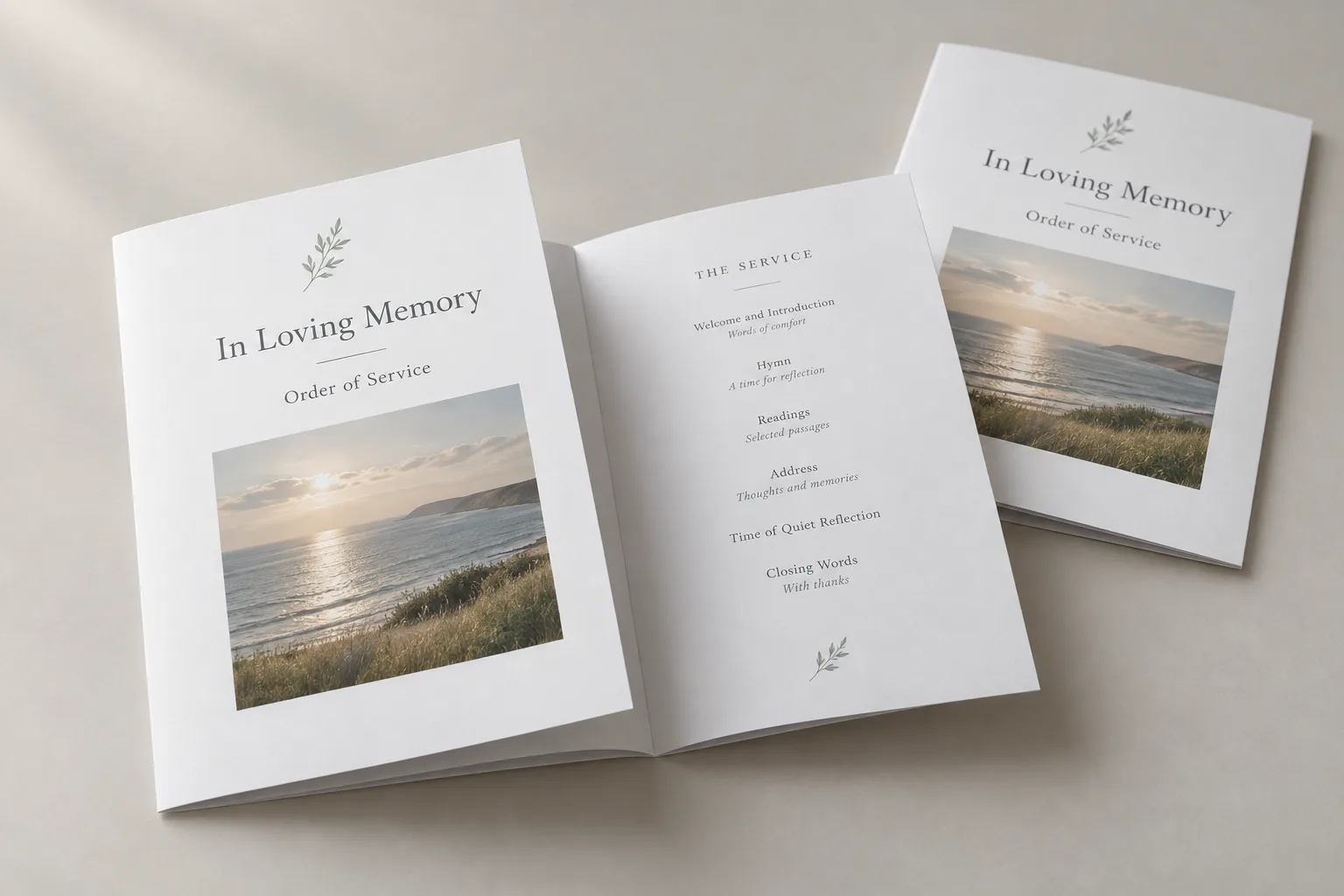
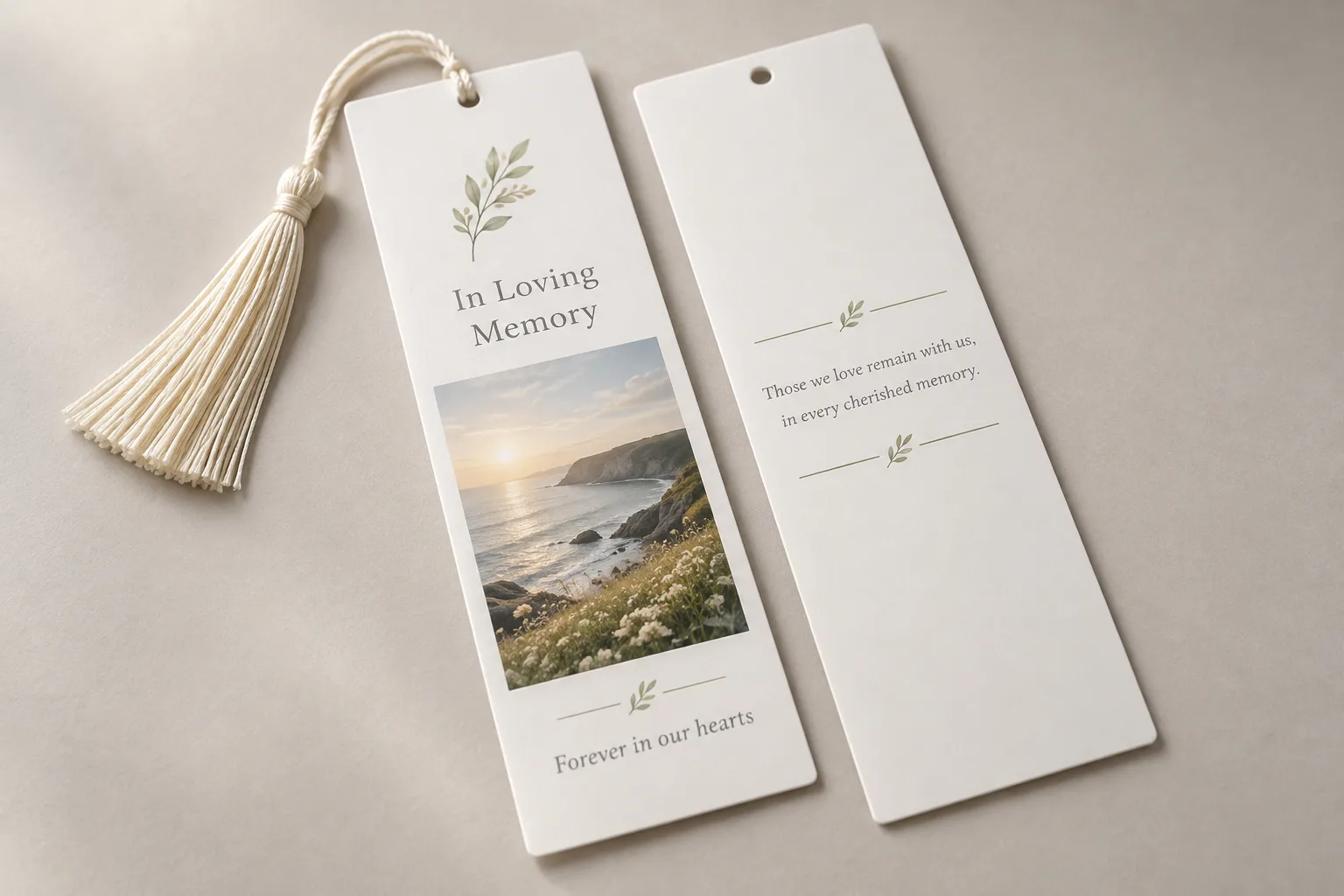


Start from a free design
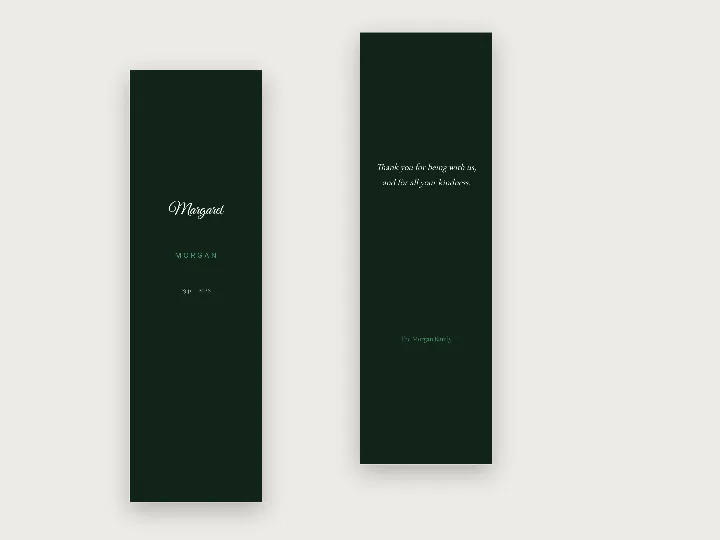
Memorial bookmarks · edit it online
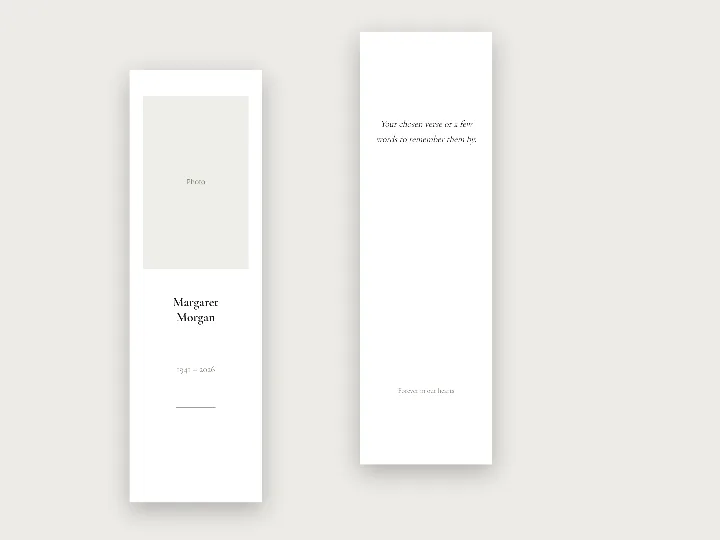
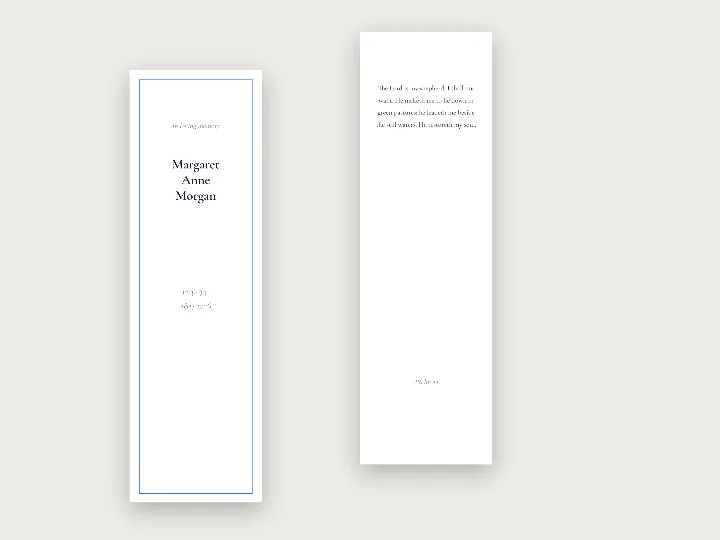
Poems
Death is nothing at all
Henry Scott Holland, 1910
Death is nothing at all.
It does not count.
I have only slipped away into the next room.
Nothing has happened.
Everything remains exactly as it was.
I am I, and you are you,
and the old life that we lived so fondly together is untouched, unchanged.
Whatever we were to each other, that we are still.
Call me by the old familiar name.
Speak of me in the easy way which you always used.
Put no difference into your tone.
Wear no forced air of solemnity or sorrow.
Laugh as we always laughed at the little jokes that we enjoyed together.
Play, smile, think of me, pray for me.
Let my name be ever the household word that it always was.
Let it be spoken without an effort, without the ghost of a shadow upon it.
Life means all that it ever meant.
It is the same as it ever was.
There is absolute and unbroken continuity.
What is this death but a negligible accident?
Why should I be out of mind because I am out of sight?
I am but waiting for you, for an interval,
somewhere very near, just round the corner.
All is well.
Crossing the Bar
Alfred, Lord Tennyson, 1889
Sunset and evening star,
And one clear call for me!
And may there be no moaning of the bar,
When I put out to sea,
But such a tide as moving seems asleep,
Too full for sound and foam,
When that which drew from out the boundless deep
Turns again home.
Twilight and evening bell,
And after that the dark!
And may there be no sadness of farewell,
When I embark;
For tho’ from out our bourne of Time and Place
The flood may bear me far,
I hope to see my Pilot face to face
When I have crost the bar.
Remember
Christina Rossetti, 1862
Remember me when I am gone away,
Gone far away into the silent land;
When you can no more hold me by the hand,
Nor I half turn to go yet turning stay.
Remember me when no more day by day
You tell me of our future that you plann’d:
Only remember me; you understand
It will be late to counsel then or pray.
Yet if you should forget me for a while
And afterwards remember, do not grieve:
For if the darkness and corruption leave
A vestige of the thoughts that once I had,
Better by far you should forget and smile
Than that you should remember and be sad.
Requiem
Robert Louis Stevenson, 1887
Under the wide and starry sky,
Dig the grave and let me lie.
Glad did I live and gladly die,
And I laid me down with a will.
This be the verse you grave for me:
Here he lies where he longed to be;
Home is the sailor, home from sea,
And the hunter home from the hill.
Farewell
Anne Brontë, 1846 · the first verse is the one usually read
Farewell to thee! but not farewell
To all my fondest thoughts of thee:
Within my heart they still shall dwell;
And they shall cheer and comfort me.
From “Song of Myself”
Walt Whitman, 1855
All goes onward and outward, nothing collapses,
And to die is different from what any one supposed, and luckier.
Scripture
King James Version, which is free to print
Psalm 23
The Lord is my shepherd; I shall not want.
He maketh me to lie down in green pastures: he leadeth me beside the still waters.
He restoreth my soul: he leadeth me in the paths of righteousness for his name’s sake.
Yea, though I walk through the valley of the shadow of death, I will fear no evil: for thou art with me; thy rod and thy staff they comfort me.
Thou preparest a table before me in the presence of mine enemies: thou anointest my head with oil; my cup runneth over.
Surely goodness and mercy shall follow me all the days of my life: and I will dwell in the house of the Lord for ever.
Ecclesiastes 3:1–8
To every thing there is a season, and a time to every purpose under the heaven:
A time to be born, and a time to die; a time to plant, and a time to pluck up that which is planted;
A time to kill, and a time to heal; a time to break down, and a time to build up;
A time to weep, and a time to laugh; a time to mourn, and a time to dance;
A time to cast away stones, and a time to gather stones together; a time to embrace, and a time to refrain from embracing;
A time to get, and a time to lose; a time to keep, and a time to cast away;
A time to rend, and a time to sew; a time to keep silence, and a time to speak;
A time to love, and a time to hate; a time of war, and a time of peace.
John 14:1–3
Let not your heart be troubled: ye believe in God, believe also in me.
In my Father’s house are many mansions: if it were not so, I would have told you. I go to prepare a place for you.
And if I go and prepare a place for you, I will come again, and receive you unto myself; that where I am, there ye may be also.
1 Corinthians 13:4–8, 13
Charity suffereth long, and is kind; charity envieth not; charity vaunteth not itself, is not puffed up,
Doth not behave itself unseemly, seeketh not her own, is not easily provoked, thinketh no evil;
Rejoiceth not in iniquity, but rejoiceth in the truth;
Beareth all things, believeth all things, hopeth all things, endureth all things.
Charity never faileth…
And now abideth faith, hope, charity, these three; but the greatest of these is charity.
Revelation 21:4
And God shall wipe away all tears from their eyes; and there shall be no more death, neither sorrow, nor crying, neither shall there be any more pain: for the former things are passed away.
Newer translations — the NIV, the NRSV, the Good News Bible — are in copyright, and most allow a short passage to be quoted in a service booklet with the translation named; check the copyright page of the Bible you are copying from.
Hymns
The words of these can be printed freely
Abide with Me
Henry Francis Lyte, 1847 · the first and last verses
Abide with me; fast falls the eventide;
The darkness deepens; Lord, with me abide.
When other helpers fail and comforts flee,
Help of the helpless, O abide with me.
Hold Thou Thy cross before my closing eyes;
Shine through the gloom and point me to the skies.
Heaven’s morning breaks, and earth’s vain shadows flee;
In life, in death, O Lord, abide with me.
Amazing Grace
John Newton, 1779 · the first two verses
Amazing grace! how sweet the sound,
That saved a wretch like me!
I once was lost, but now am found,
Was blind, but now I see.
’Twas grace that taught my heart to fear,
And grace my fears relieved;
How precious did that grace appear
The hour I first believed!
The Lord’s my Shepherd
Scottish Psalter, 1650 · sung to Crimond
The Lord’s my Shepherd, I’ll not want;
He makes me down to lie
In pastures green; He leadeth me
The quiet waters by.
Yea, though I walk in death’s dark vale,
Yet will I fear none ill:
For Thou art with me; and Thy rod
And staff me comfort still.
Also free to print
Nearer, My God, to Thee (Sarah Flower Adams, 1841) · Rock of Ages (Augustus Toplady, 1763) · Jerusalem (William Blake, 1808) · The Day Thou Gavest, Lord, Is Ended (John Ellerton, 1870) · Eternal Father, Strong to Save (William Whiting, 1860) · Guide Me, O Thou Great Redeemer (William Williams, in the 1771 English translation) · Ave Maria and the Latin texts of the Requiem Mass.
Well-known ones to ask about first
Loved, often read aloud, and still in copyright
These are read at funerals every week, and reading them aloud is fine. Printing the full words in the order of service is a different thing: ask the celebrant, the church or the funeral director whether their licence covers it, or print the title and the author and leave the words to be read.
- Do Not Stand at My Grave and Weep — attributed to Mary Elizabeth Frye, 1932. Its authorship was disputed for decades and it is often treated as free; many printers still ask.
- Funeral Blues (“Stop all the clocks”) — W. H. Auden, 1938.
- She Is Gone / He Is Gone (“You can shed tears that she is gone”) — David Harkins, 1981.
- Do Not Go Gentle into That Good Night — Dylan Thomas, 1951.
- How Great Thou Art — the English words are Stuart K. Hine’s, 1949, and are licensed.
- My Country (“I love a sunburnt country”) — Dorothea Mackellar, 1908. She died in 1968, so in Australia the poem stays in copyright until 2038.
- Any song from the radio — the lyrics are licensed, however old the recording feels.
Putting the words on the page
A reading goes on the inside right page of an A5 folded order of service, after the running order; a hymn people sing goes in the order itself, at the point it is sung, so nobody has to turn the page mid-verse. Set the words a size smaller than the running order, with a line between verses. If there are two readings and a hymn, it is an 8-page booklet rather than a folded card.
The free template flows the reading after the order and tells you if it does not fit. If you would rather send the wording and have it set and printed, the order of service is quoted the same business day.
Common questions
Can we print the words of a poem in a funeral booklet?
If the poet died more than seventy years ago, yes, freely. If not, the words are in copyright and printing them needs permission — from the publisher, or under a licence the church or the celebrant may hold. Reading the poem aloud at the service is not restricted.
Is Psalm 23 free to print?
In the King James Version, yes; its text is out of copyright. In a modern translation, the publisher usually allows a short passage in a service booklet if the translation is named, and the Bible’s copyright page says exactly what is permitted.
Can we print the words of Amazing Grace?
Yes. John Newton wrote the words in 1779, and the traditional hymns of that century and the next are all out of copyright.
What about a song that was played at the service?
The title and the artist can be printed in the running order — “Entrance music: Time to Say Goodbye” — without any permission. The lyrics cannot be printed in full without a licence.
Who can tell us for sure?
The celebrant, the church office or the funeral director. Churches that hold a copyright licence for their services know what it covers, and funeral directors print orders of service every week and know which words are asked about.
Related
The free template
Type the wording, add a photograph and a reading, and download the print-ready PDF.
Five running orders
A Catholic Mass, a church service, a celebration of life, a committal and a memorial service, written out in full.
Memorial bookmarks
A verse and a photograph on a laminated keepsake, to hand out or post afterwards.
Last updated .