Guide · stock & format
Restaurant menu printing: stock, format and when to reprint
Where the menu lives decides the paper. A menu handled every service wants 250gsm and a laminate, or a synthetic sheet if it has to last a year. A takeaway menu that ends up on a fridge is fine on 150gsm. The format follows the length of the menu, and the takeaway version is a re-typeset of the dine-in one, not a shrunk copy.
Where the menu lives decides the stock
Menus fail in two ways: they get handled to death, or they go out of date. The first is a stock question and the second is a reprint question, and it pays to treat them separately, because the cheapest answer to one is the wrong answer to the other.
| Where it lives | What happens to it | Stock | Finish |
|---|---|---|---|
| On the table, every service | Handled, wiped, spilled on, folded by a child | 250–350gsm | Laminate, or synthetic if it stands for a year |
| In a booklet or cover | Opened a hundred times a night, pages turned | 150–200gsm inside, 300gsm cover | Laminate the cover; leave the pages uncoated |
| Takeaway, handed out or letterboxed | Read once, kept on a fridge, thrown away | 150gsm | None; gloss stock is enough |
| At the counter or the till | Glanced at, rarely touched | 250gsm | Matt laminate, so it does not glare under the lights |
| Specials, changed weekly | Printed in-house, replaced often | Whatever the office printer takes | None; put it in a holder or an A-frame |
The two extremes are where money is wasted. A laminated 350gsm takeaway menu costs several times what a 150gsm one does and lasts no longer on a fridge. An unlaminated 150gsm dine-in menu is soft at the corners within a week and replaced before the prices change. Match the stock to the life the menu will have, not to the budget or to the look.
What we print for this
Proofed before they run
Start from a free design
Restaurant menus · edit it online
Laminated or synthetic
A laminated menu is paper sealed between two films. The faces wipe clean, but the edge is still paper, so it goes first where hands and spills reach it, and it can crack if it is folded. A synthetic sheet is plastic all the way through: it wipes, it does not swell, and it folds without cracking. It costs more per sheet, which is why the rule is about how long the menu stands. Laminate is right for a menu that changes seasonally and is reprinted anyway. Synthetic pays for itself on one that stands for a year, or on any menu that meets water: a cafe courtyard, a bar, anything near a kitchen pass. Laminate finishes covers matt against gloss; for menus, matt wins under restaurant lighting.
The six formats, and which menu each one fits
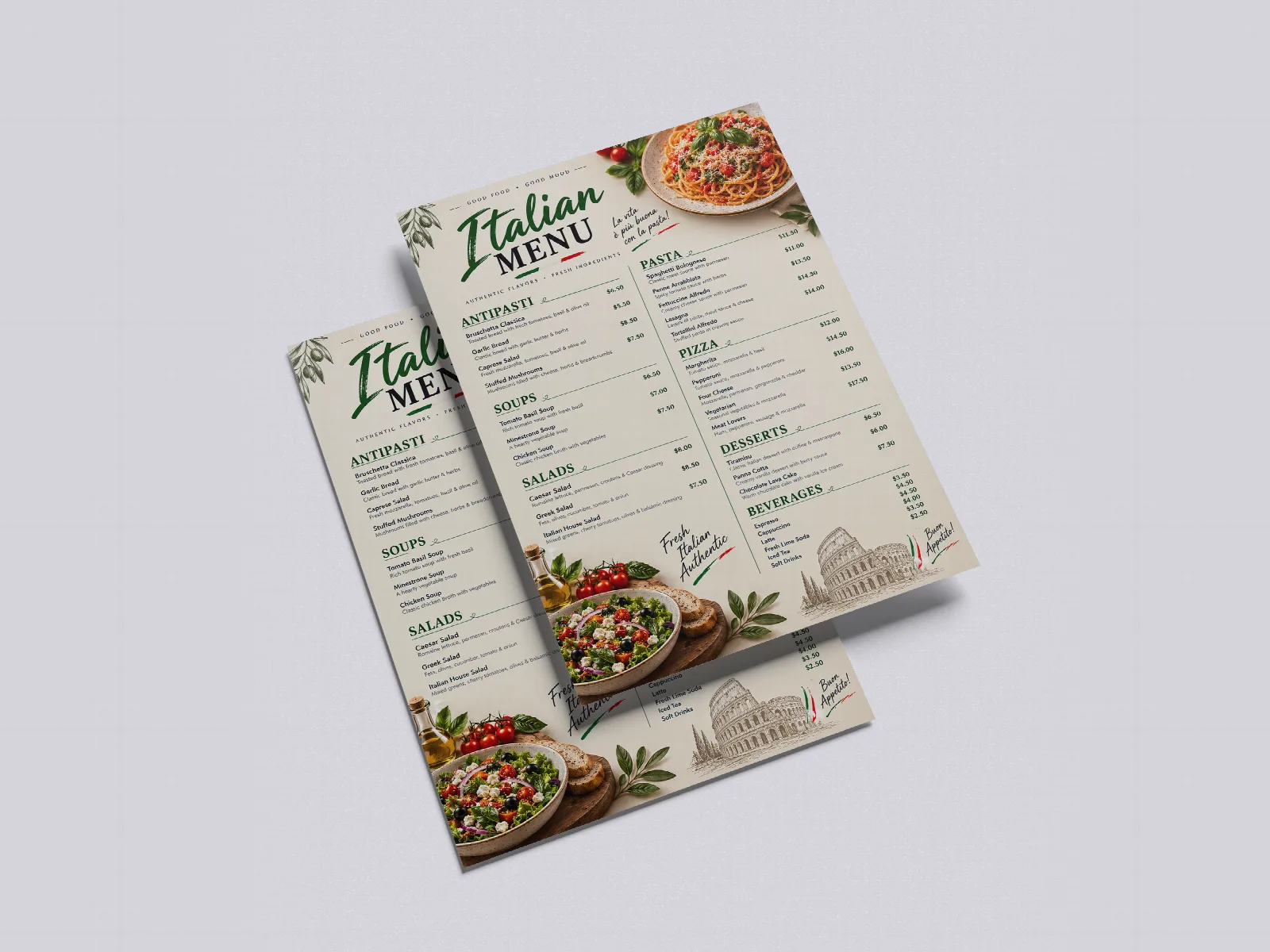
- Flat A3. The dine-in sheet for a big single menu. One side, or two if drinks go on the back. Laminated or synthetic, twenty to a hundred copies.
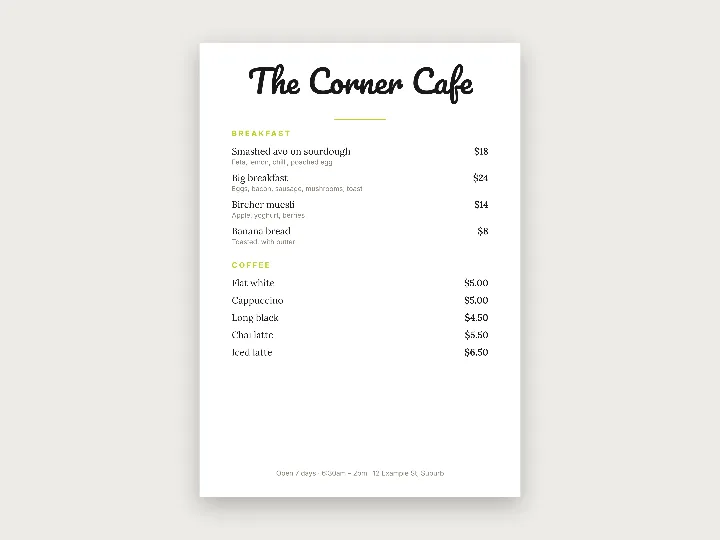
- Flat A4, one page. Cafes and short menus that change weekly. Cheap enough to reprint on every change, or laminated to reuse.
- Booklet. A big menu and a wine list, eight to sixteen pages, saddle-stitched with a heavier cover. Thirty to a hundred copies, and the one format where a price change is a real reprint, which is why the cover and the pages are best kept as separate files.
- A4 roll-folded to DL, six panels. The standard takeaway menu and letterbox drop. Five hundred to two and a half thousand.
- 8pp roll-fold DL. The bigger takeaway menu, for a kitchen with a hundred dishes. Same run sizes.
- Bi-fold DL, four panels. Small takeaway, pizza, or a drinks list on its own.
Two of those are priced on this site as they stand: a flat A4 on the flyers configurator, from $0.47 each at 250 on 250gsm gloss, and the six-panel roll fold on brochures. The other four are quoted on restaurant menus, as are laminate and synthetic stock.
Book menu to takeaway: what a remap actually does
The mistake is to shrink the dine-in menu until it fits. Shrunk type is unreadable at DL size, and a takeaway customer is not reading the same menu anyway: they are not choosing a wine, they do not need the story of the farm, and they want the phone number and the ordering hours on the front.
A remap is a re-typeset. The sections are chosen for takeaway, dishes that do not travel come off, the dish names and prices are set at a size that reads in a car, and the look of the dine-in menu is kept so the two belong to the same restaurant. As a rule of thumb, a six-panel DL carries a menu of forty to sixty lines comfortably; past that, the 8pp fold, or a flat A4 with two columns. That is the job sold as book menu to takeaway, from $249, and it is the one restaurants ask for most after price updates.
How often menus get reprinted, and how many to print
Prices move two or three times a year now, and a menu that cannot be updated cheaply gets a sticker over the old price, which every customer notices. So the reprint plan matters more than the first print. Keep the file, keep the design, and change only the prices: a price update is from $49, and free with a reprint of 500 or more.
How many: for dine-in, roughly one menu per two seats plus a third again for wear and spills, so a sixty-seat room runs forty to fifty. For takeaway, order for the number you will hand out or letterbox in the next two to three months rather than a year, so a price change does not strand a box of them. That is why takeaway menus run from 500 and why 500 flat DL flyers are $94.50.
The menu somebody made with AI
A growing share of the menus sent for printing were made with an image generator. They look finished on a screen and go wrong on paper for one reason: the text was never type. The generator drew letter-shaped marks, so the file carries typos, invented characters, dishes that do not exist and prices nobody can edit, and it prints soft at any size. Printing AI-generated artwork explains why no software fixes that. The fix is to keep the look and set every word again in real type, corrected against the restaurant's own list, which is the job sold as AI-generated menu fixed, from $249.
Allergens and dietary marks
Icons for vegetarian, vegan, gluten-free and the common allergens are set as part of any menu job. The content is the restaurant's to specify and confirm: we set exactly what is supplied and approved on the proof, and nothing on a menu is guessed.
The clock. Design is 2 working days for a price update and 3 to 5 for a remap, an AI fix or a new menu, to a proof approved on your phone. Then 2-4 working days printed and delivered. Need it sooner? Ask — a tighter date is quoted per job.
Next
Last updated .